How We Review AI Coding Tools for Accuracy
Not every coding assistant fails in the same way. Some generate fast but brittle code. Others reason more carefully but interrupt flow with overly cautious suggestions. A useful review framework needs to isolate those tradeoffs so readers can map the tool to their real environment.
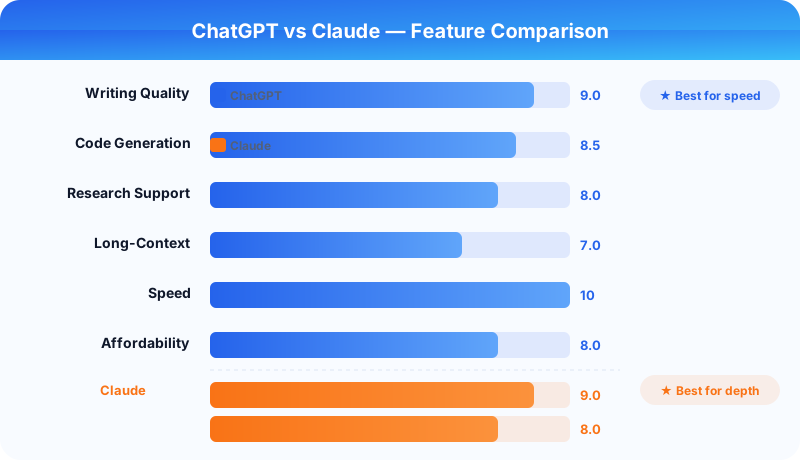
Why a review framework matters
AI coding tools are difficult to compare because demos hide the constraints that shape daily usage. Prompt quality, repository size, language support, latency, and debugging depth all change the experience. We treat reviews as workflow evaluations rather than feature lists.
Key Takeaways
- AI coding tools vary dramatically in accuracy depending on your tech stack and codebase size
- Speed is not always an advantage — faster tools often require more manual correction
- The best tool for prototyping may be different from the best tool for production code
Testing real workflows
We test first-run onboarding, small bug fixes, file-level refactors, explanation quality, and how well the assistant recovers from ambiguous requirements. The goal is to understand whether the product saves time once the easy tasks are gone.
Advantages of a structured review
- Consistent scoring across different tool categories
- Readers can directly compare their priorities
- Reduces marketing noise from vendor claims
Limitations to keep in mind
- Individual results vary by team and workflow
- Tools update frequently — reviews are snapshots
- Free tiers may not represent paid experience
Accuracy versus speed
A tool that replies quickly is not always the better choice. We track how often outputs need correction, whether test failures are understood, and how much supervision is required before code is safe to merge. High speed with low reliability usually creates negative leverage.
Signals we look for
- Does the assistant respect existing patterns in the codebase?
- Can it follow multi-step instructions without drifting?
- Does it explain uncertainty when context is incomplete?
Risk and trust signals
We also consider privacy controls, enterprise readiness, and whether the vendor clearly explains model limitations. For teams shipping production software, trust is part of the feature set.
Related Articles